WeChat Attention
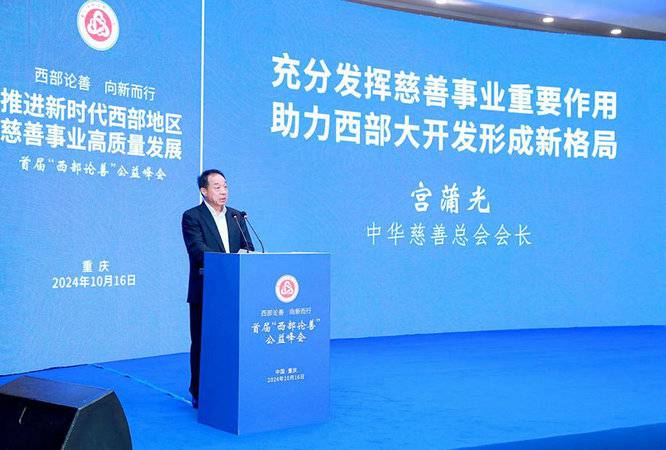
Keynote Speech at the “Philanthropy Discussion Forum in Western China”
(Oct. 16, 2024)
Dear guests and friends,
It is a great pleasure to gather with all of you in the magical city of Chongqing to participate in the “Philanthropy Discussion Forum in Western China” co-hosted by Chongqing Charity Federation and charity organizations from western provinces and regions. Hereby, we are exploring new paths for the high-quality development of charity in the western region in the new era. On behalf of China Charity Federation, I would like to extend my warm congratulations on the successful holding of the “Philanthropy Discussion Forum in Western China”. I also express my highest respect to the leaders of the Party and government at all levels in Chongqing and to people from all walks of life who have long supported the development of charity.
Charity is an important component of socialism with Chinese characteristics. The Party and the state have always attached great importance to the development of charity, especially since the 18th National Congress of the Communist Party of China, the Party Central Committee with Comrade Xi Jinping at its core has recognized charity not only as an important part of a broad moral practice and a multi-tiered social security system, but also as a crucial component of our basic economic system, especially the income distribution system. The Third Plenary Session of the 20th CPC Central Committee again reiterated the need to "support the development of public welfare charities," which provides fundamental political guarantees for the high-quality development of charity in the new era. Over the years, the 12 western provinces (municipalities and autonomous regions) have not only experienced rapid economic and social development, but also have closely integrated their unique characteristics with the vigorous development of charity. They have continuously deepened charity cooperation between the east and west, actively explored new methods, and accumulated valuable experiences, forming new models that are feasible and replicable. Just now, the introductions by Deputy Director of the General Office of Chongqing Municipal People’s Government, Tao Xiaofeng and President of Chongqing Charity Federation, Liu Guanglei have allowed us to truly feel the vibrant vitality and strong momentum of charity in the western region, with Chongqing serving as a key window. In recent years, Chongqing has consistently adhered to the principle of charity for the people and charitable deeds in accordance with the law, mobilizing social forces extensively. It has played a significant role in areas such as poverty alleviation, medical and educational support, rural revitalization, and disaster relief. Chongqing Charity Federation has not only created a strong brand in the fields of internet charity and community charity, but also has played a leading, coordinating, and guiding role in the development of Chongqing's charity sector. It has made a key contribution to the development of charitable work in Chongqing and the high-quality development of charity across the country. I would like to take this opportunity to express my highest respect and heartfelt gratitude to the charity peers in Chongqing and the other 11 western provinces (autonomous regions).
Now, based on the study and implementation of the spirit of the Third Plenary Session of the 20th CPC Central Committee, I would like to share a few thoughts on the important position of charity in the western region and its high-quality development.
I. Further Advancing the Western Development Strategy is a Major Strategic Deployment for Chinese Path To Modernization
The western region of China is an important ecological barrier, a treasure trove of resources, and a strategic area. It accounts for more than two-thirds of the country's total land area, 80% of its land borders, nearly one-third of its provincial-level administrative divisions, and over one-fifth of its population. Its GDP accounts for nearly a quarter of the national total, making it of significant strategic importance in the overall development and security of the country. The Party and the state have always attached great importance to the development of the western region, launching the Western Development Strategy at the beginning of this century. In the new era, the Party Central Committee with Comrade Xi Jinping at its core has deployed the Western Development Strategy as a key component of Chinese path to modernization. The Third Plenary Session of the 20th CPC Central Committee emphasized the need to "We will usher in a new stage in large-scale development in the western region, promote breakthroughs in the revitalization of northeast China, accelerate the rise of the central region, and encourage the eastern region to accelerate modernization." In August this year, the Central Committee specifically issued the Several Policy Measures for Further Promoting the Formation of a New Pattern of Western Development, which clearly calls for "accurately grasping the position and mission of the Western Development Strategy in advancing Chinese path to modernization, focusing on major environmental protection, opening up, and high-quality development, accelerating the formation of a new development pattern, and enhancing regional overall strength and sustainable development capacity." This fully demonstrates that further advancing the Western Development Strategy to create a new pattern is of great practical and historical significance. It plays a crucial role in promoting regional coordinated development, strengthening ethnic unity, consolidating national defense, safeguarding national security and stability, preventing and resolving various risks, and achieving the great rejuvenation of the Chinese nation.
First, the western region is the cornerstone of China's ecological security. The vast western region serves as an important ecological barrier for the country. From the snow-capped mountains and glaciers of the Tibetan Plateau to the deserts and grasslands of Inner Mongolia, from the high mountains and valleys of the Yunnan-Guizhou Plateau to the Gobi Deserts of the northwest, the region's ecosystems are both diverse and fragile. The ecological environment of the western region not only impacts the quality of life for local residents but also acts as a crucial barrier for national ecological security. For example, the Origin of the Three Rivers is known as China's "water tower", provides vital water resources that sustain millions of people. Protecting the ecological environment of the western region is essential for the country's sustainable development and is a solemn promise to future generations.
Second, the western region is a strategic resource hub for China. The western region of China is a vital energy and resource treasure trove for the country. The abundance of coal, oil, natural gas, and non-ferrous metals provides a solid material foundation for the country's economic construction. As global energy dynamics shift and the nation accelerates its industrialization, the resource advantages of the western region have become increasingly prominent. Take Xinjiang, Sichuan, and Chongqing, for example: their rich oil and natural gas resources are crucial to the nation's energy security. Moreover, the region's unique agricultural and tourism resources also have vast potential for development, offering significant space for economic diversification.
Third, the western region is a new frontier for China's opening-up. In the context of the Belt and Road Initiative, the western region has become an important gateway for China's opening to the west. Its unique geographical location connects it closely with Central Asia, South Asia, and West Asia, making it a crucial bridge linking the East and the West. Key border ports like the Khorgos Port in Xinjiang, the Alashankou Port, the Lanzhou New Area in Gansu, the Dongxing Port in Guangxi, and the Ruili Port in Yunnan, are all significant nodes in the construction of the "Belt and Road." Strengthening the western region's openness will not only promote international trade and investment, but also enhance cultural exchanges and cooperation, injecting new vitality into the country's economic development.
Fourth, the western region is a fortress for national unity. The western region is home to the majority of China's ethnic minorities, with nearly 80% of the country's ethnic minorities living and developing together in this area, creating a rich and diverse ethnic culture. Promoting the development of the western region is crucial for advancing ethnic unity and maintaining social stability in border areas. The development and stability of the western region, along with the unity and harmony between its ethnic groups, is not only vital for the long-term peace and stability of the country, but also key to strengthening the consciousness of the Chinese national community and enhancing national cohesion and awareness.
Given the western region's unique strategic position, the Western Development Strategy is not only about promoting economic growth in the western region, but also is an integral part of the overall national development. It involves important aspects of ecological security, social stability, ethnic unity, and national security. Therefore, it is a critical strategic deployment that impacts the country's future trajectory.
II. The Important Mission of Charitable Work in the New Pattern of Western Development
The Central Committee has clearly stated that the formation of a new pattern for the Western Development Strategy involves deepening reforms, further liberating and developing social productivity in the western region, stimulating and enhancing social vitality, strengthening and expanding industries with unique advantages, and promoting the transformation and upgrading of traditional industries. It also emphasizes high-level protection, advancing the construction of a beautiful western region, addressing environmental pollution, promoting green and low-carbon development, advancing new-type urbanization suited to local conditions, vigorously promoting comprehensive rural revitalization, consolidating and expanding the achievements of poverty alleviation, and ensuring that rural populations return to poverty on a large scale or fall into new poverty. Additionally, it stresses the importance of consolidating the sense of Chinese national community, effectively maintaining ethnic unity, and ensuring the stability of border areas. Philanthropy in the new era, as an important part of the Chinese-style modernization, shoulders an important mission to promote the formation of a new pattern of western development.
First, charitable work serves as a regulator for supporting the vulnerable, promoting common prosperity, and maintaining social fairness in the western region. Due to historical and geographical reasons, although the western region has achieved comprehensive poverty alleviation, it still remains economically underdeveloped compared to other parts of the country. As it moves toward common prosperity, issues of social fairness remain prominent. Charity is an important component of China's social security system. It plays a significant role in assisting struggling communities, participating in rural revitalization, and narrowing the gaps between regions, urban and rural areas, and different social groups. Charity efforts can contribute greatly to common prosperity and social equity. Through charitable platforms, we can mobilize societal goodwill to provide assistance in areas such as living expenses, medical aid, and educational support for vulnerable groups like impoverished families, the disabled, elderly people living alone, and left-behind children. This helps address urgent issues and allows these groups to experience the warmth and care of society.
Second, charitable work acts as a booster for economic development in the western region. As a main channel for the third distribution of wealth, charity is an important part of China's economic system, particularly its distribution system, and can play a significant role in the Western Development Strategy. Charitable organizations can bridge connections between social enterprises, philanthropists, and public resources to attract donations in the form of funds, materials, and technologies. This can support infrastructure construction, assist in the development of characteristic industries, help improve the skills of farmers, and increase their capacity for wealth creation. For example, building bridges and roads in remote mountainous areas, improving local transportation, education, and medical facilities, can create a favorable hardware environment for economic development and contribute to industrial upgrading and transformation, thus accelerating economic and social progress.
Third, charitable work is a pioneer in ecological construction in the western region. The newly amended Charity Law further clarifies that environmental protection is an important aspect of charitable activities. Charity organizations can play a significant role in ecological conservation in the western region by mobilizing the forces of all sectors of society, thus helping to address the resource and capacity gaps that the government may face in environmental protection. Through charitable platforms, uniting the forces and resources of all sectors of society to participate in ecological and environmental construction, and carrying out charity projects such as ecological restoration, species protection, environmental monitoring, ecological agriculture, eco-tourism, and the development of green energy, can explore new ideas, new paths, and new methods for charitable involvement in ecological and environmental construction in the western region.
Fourth, charitable work is a catalyst for cultural development in the western region. The western region boasts a long history and a rich multi-ethnic culture. Preserving and promoting outstanding ethnic cultures is an essential part of charitable work. Charitable organizations, through cultural charity projects, can support the protection of cultural heritage, the transmission of intangible cultural heritage, cultural and artistic creation, promotion of unique cultures, and cultural exchange activities in the western region, particularly in border areas with large minority populations. This can help protect and inherit traditional cultures, and promote cultural innovation and development.
Fifth, charitable work is an enhancer of ethnic unity and social harmony in the western region. The western region is home to many ethnic groups, and ethnic unity is the foundation of social stability and harmony. Charity is an act of selfless giving, representing people's compassion and sense of social responsibility. It is a powerful force for strengthening social cohesion. In the western region, charity plays a critical role in promoting ethnic unity. Charitable activities, such as helping the vulnerable, providing educational and medical assistance, and protecting the environment, directly improve the lives of local communities, enhance their happiness, foster feelings of goodwill among different ethnic groups, and promote unity and social harmony.
III. Adhering to Integrity and Innovation, Promoting the High-Quality Development of Charity in Western China
Since the reform and opening-up, particularly after the 18th National Congress of the Communist Party of China, with the rapid development of the economy and society, charitable and public welfare causes in Western China have made remarkable progress. Some provinces and cities have taken the lead nationally in charitable work. For example, Chongqing's "Online Charity," Shaanxi's "Charity Happy Homeland," and Sichuan's "Shu Charity Neighbor" have become nationally recognized initiatives. However, it is also important to acknowledge that charitable causes in Western China still face several challenges, such as relatively small donation scales, low levels of charitable organizations, a shortage of professional talent, weak regulatory capabilities, and a poor public opinion environment. In light of these challenges, the charity sector in Chongqing and Western China should take full advantage of the strong momentum provided by the spirit of the Third Plenary Session of the 20th CPC Central Committee and General Secretary Xi Jinping's important instructions on the western development in April of this year. By adhering to the principles of integrity and innovation, we should deepen reform, tap into existing potential, strengthen advantages, overcome weaknesses, and advance with determination. This will help us promote the high-quality development of charitable causes and contribute to the creation of a new development pattern for the Western Development Initiative. To achieve this goal, I believe the following key points are essential:
I. Resolutely Follow the Path of Charitable Development with Chinese Characteristics Charity is a common value for all humanity, but Chinese charity has many differences from Western charity in terms of historical evolution, cultural foundation, social functions, political attributes, and development models. Under the leadership of the Communist Party of China, China's charity system is rooted in the country's unique national conditions, inheriting and promoting the spirit of traditional charity culture. We should draw on successful experiences from international charity initiatives, integrate features of modern charity systems, and forge a distinctive path of charitable development with Chinese characteristics. This is the only way to ensure the high-quality development of charity in China, including in the western regions. To follow this path, we must clearly and unequivocally uphold the Party's comprehensive leadership over charitable causes, unwaveringly follow the political development path of socialism with Chinese characteristics, and fully leverage the political core role of Party organizations. This will ensure that charitable work better serves the Party's commitment to the people, responding timely to the Party's calls, loyally assisting the Party, cooperating actively with the government, and mobilizing societal forces. In this way, we can stimulate social vitality, mobilize resources, and fully realize the potential of charitable causes in areas such as consolidating and expanding poverty alleviation achievements, implementing rural revitalization strategies, and advancing social welfare, elder care services, community governance, and other initiatives benefiting the people.
II. Upholding the Rule of Law to Promote Charity and Creating a Favorable Social Environment for Charitable Development Promoting charity in accordance with the law is an important component of the rule of law in the country and a fundamental guarantee for the high-quality development of charitable causes. The newly amended Charity Law, which came into effect in September this year, provides a strong impetus for this cause. We must seize this momentum to deeply study, thoroughly understand, accurately grasp, and fully implement the law, ensuring that charity is promoted, governed, and carried out in accordance with the law. First, we must enhance society's awareness of charitable causes. The study and promotion of the Charity Law should be closely integrated with General Secretary Xi Jinping's important instructions on vigorously developing charity. This will help unify the thoughts of the entire society, raise awareness of the importance of charitable causes, and actively advocate for a new cultural norm of "charity for all" and "charity for the masses." Second, efforts should be made to implement the specific policies and measures outlined in the amended Charity Law. The new law strengthens leadership, improves institutional mechanisms, and provides many favorable policies for various types of charitable activities, especially for charitable organizations involved in fundraising, emergency charity, and charitable trusts. It also further enhances policy support in areas such as land use, financial policies, service purchases, talent development, and recognition. These incentives are a tremendous boost to the development of the charity sector and are crucial for long-term progress. However, the Charity Law primarily establishes basic principles. These principles still require relevant departments to formulate corresponding administrative regulations or policy norms to bring them into practice. This requires collective efforts at both national and local levels to continuously advocate for and actively work towards the prompt introduction of supporting regulations, so that the policy benefits outlined in the Charity Law can be implemented with greater scope and stronger force. Finally, charitable organizations at all levels must, in line with the new law, not only accelerate the development of charity, but also manage their operations strictly, standardize processes, and ensure transparency. They should continuously improve the management and internal governance of charity projects to enhance the credibility of charitable and public welfare organizations. Under the leadership of Party committees and governments at all levels, we must strive to create a charitable ecosystem that is well-coordinated, healthy, orderly, and characterized by multi-party cooperation, thereby fostering a sound governance framework for the charity sector.
III. Upholding National Priorities and Actively Contributing to National Strategies. Charity is an important component of socialism with Chinese characteristics. We must closely align ourselves with the major strategic deployments of the Party and the nation, focusing on the "national priorities" and actively contributing our efforts to them. For the western region, in addition to the common economic and social development challenges faced across the country, the national priorities include "developing border areas and enriching the people," "ethnic unity," "stabilizing the frontier," and "strengthening national defense." Eighty percent of China's land borders and five ethnic autonomous regions are located in the western region. As General Secretary Xi Jinping has pointed out, "To govern the country, we must govern the borders," emphasizing the profound connection between border governance and the overall governance of the country, highlighting the shift in the national governance system from a defensive approach to proactive management. Border governance must not only strengthen ethnic unity, promote social harmony and stability, consolidate national defense, and ensure national security, but also accelerate economic prosperity, social progress, and the improvement of people's livelihoods in border areas. This will achieve a balanced and sustainable national development. Therefore, the development of charity in the western region must closely align with this "national priority," respond to the country's call, and actively engage in major national strategies such as rural revitalization and targeted assistance to Xinjiang and Tibet. This includes carrying out diversified charitable assistance projects, precisely addressing the actual needs of ethnic minority areas in frontier regions such as Tibet and Xinjiang, and increasing the intensity of charitable support.
At the same time, we must leverage the national charity network's advantages to strengthen cooperation between the eastern and western regions, promote joint efforts between charity organizations in both regions, capitalize on each other's strengths, and complement each other's advantages. This includes sharing information on charity resources, project needs, and donation intentions, exploring joint fundraising by eastern and western charitable organizations, and collaborating on the planning and implementation of charity projects. Through these initiatives, we can fully demonstrate the powerful positive energy of charity in supporting the western region's development.
Responding to the "Belt and Road" initiative is a key opportunity for the western region to enhance its level of openness. Currently, the Western Development Strategy has resulted in the formation of several important economic zones, such as the core area of the Silk Road Economic Belt in Xinjiang, the Silk Road Economic Belt in Shaanxi and Gansu, the open hub of Sichuan and Chongqing, the China-Mongolia-Russia Economic Corridor in Inner Mongolia, and the Lancang-Mekong Regional Open Gateway in Yunnan. These are not only significant achievements of the Western Development Strategy, but also important nodes in the "Belt and Road" initiative and critical support for the western region's opening up. The charitable and public welfare sector in the western region should capitalize on the solid foundation laid by the Western Development Strategy to actively integrate into the national strategy of jointly building the "Belt and Road." Charitable organizations should extend their reach beyond China's borders to the countries along the Belt and Road, promoting "people-to-people ties" through charity and contributing the power of charitable public welfare to the country's major strategic initiatives.
IV. Vigorously Promoting the Modernization of Charitable and Public Welfare Undertakings Charitable and public welfare undertakings are an important part of Chinese path to modernization. Currently, China's charity sector has evolved from traditional charity to modern charity, from individual acts to professionalized social endeavors, from charity led by a few elites to mass charity, from offline charity to a combination of online and offline charity, and from charity aimed narrowly at alleviating poverty to a broader charity focused on societal progress. In light of these developments, achieving high-quality development in charitable causes in the western region requires a strong push towards the modernization of charity. First, we must promote the professionalization of charitable efforts. Charitable organizations and professionals should possess more specialized knowledge and skills in areas such as charity project design, online and offline fundraising, project management, and organizing charitable activities. The development of the talent pool in the charity sector must also follow a path toward greater specialization and professionalism. Second, we must modernize charitable methods. In the internet era, charitable work must keep pace with the times, making full use of modern technologies such as the internet, big data, blockchain, and artificial intelligence (AI). Platforms like TikTok, Weibo, and WeChat, among others, should be leveraged to promote finger-tip charity and online charity, improving the efficiency of fundraising and project management. This will also help innovate the forms of charitable activities, encouraging greater public participation in charitable endeavors. Third, we must promote diversification in charitable activities. In addition to traditional charity projects, we should encourage the development of charitable trusts, equity donations, intellectual property donations, and intangible asset donations. Charity donations and project implementation should embrace bold new ideas and open new channels. We must also implement the new provisions in the amended Charity Law regarding emergency charity, carefully summarize experiences from epidemic control and major disaster relief, and establish a coordinated mechanism for charity work during emergencies. It is essential to adhere to the principle of charity for the people, vigorously developing community charity, establishing community charitable organizations in line with the Charity Law, and organizing community charity activities. This will bring charity closer to the people and ensure that they feel a greater sense of fulfillment.
Comrades and friends: let us, under the guidance of the spirit of the Third Plenary Session of the 20th CPC Central Committee, earnestly fulfill the sacred mission of the charitable and public welfare sector. In contributing to the new framework for the western region's development, we will work towards the high-quality development of charitable causes.
Thank you all!